
From Receipts to Insights: How AI Is Changing Expense Management
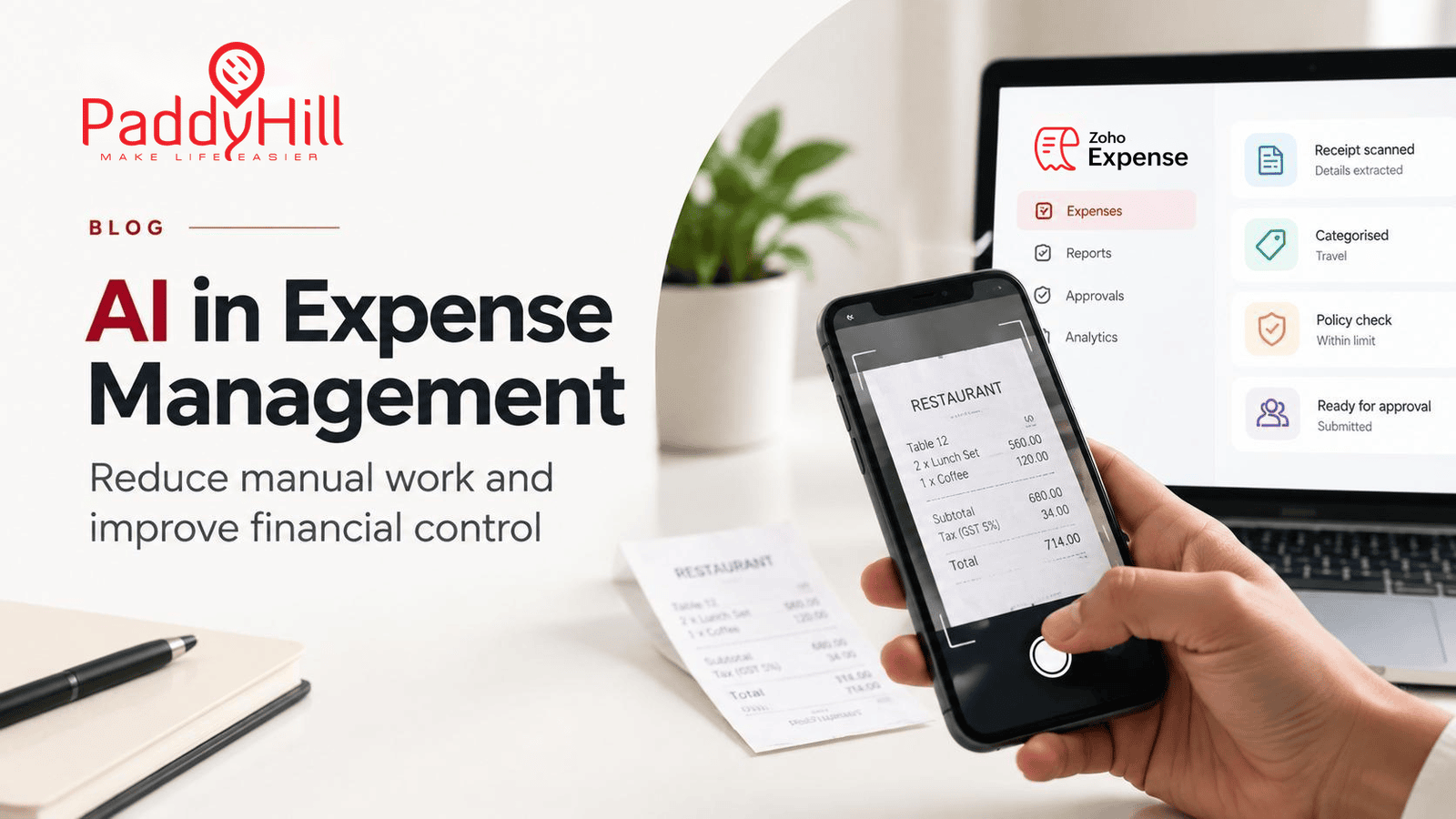
Expense management is an essential business activity, but the process behind it can be surprisingly time-consuming.
Employees collect receipts and submit claims. Managers review expenses and approve reimbursements. Accountants verify transactions, check supporting documents, reconcile payments and prepare reports.
When these activities are handled manually, even routine expenses can generate repeated follow-ups, data-entry work and delays.
For small and medium-sized businesses, the challenge is particularly significant. The same finance team may already be responsible for bookkeeping, taxation, payroll, compliance and management reporting.
AI-powered expense management offers an opportunity to reduce repetitive work while improving visibility and control over business spending.
Why traditional expense management consumes so much time
The administrative burden of expense management extends beyond entering figures into accounting software.
A typical expense process may involve:
Collecting and storing receipts.
Entering merchant names, dates, amounts and tax details.
- Collecting and storing receipts.
- Entering merchant names, dates, amounts and tax details.
- Classifying expenses under the correct categories.
- Checking whether supporting documents are complete.
- Reviewing claims against company policies.
- Obtaining approvals from the appropriate managers.
- Matching expenses with bank or corporate card transactions.
- Recording transactions and preparing expense reports.
- Following up on missing information and unresolved claims.
Each task may take only a few minutes. When repeated across multiple employees and transactions, the accumulated effort becomes substantial.
Manual processes can also lead to inconsistent categorisation, delayed reporting and difficulty identifying unusual spending.
How AI can improve expense managementAI can support several stages of the expense lifecycle, helping businesses move beyond basic digital record-keeping.
1. Automated receipt scanning and data extraction
Manually entering receipt details is one of the most repetitive parts of expense processing.
AI-assisted receipt scanning can extract information such as the merchant name, transaction date, amount and currency from uploaded receipts. This information can then be used to create an expense entry, reducing the need for manual data entry.
Employees and finance teams can review the extracted information and correct any errors before finalising the record.
2. Expense categorisation
Every transaction must be assigned to an appropriate expense category for accurate accounting and reporting.
Automated categorisation can reduce repetitive work by suggesting or assigning categories based on transaction details and available history.
Consistent categorisation helps businesses produce more meaningful reports and understand where money is being spent.
3. Policy checks and exception detection
An expense may be incorrectly categorised, exceed an approved limit, lack a required receipt or appear to duplicate an earlier claim.
AI-assisted checks can help identify potential issues and bring them to the attention of employees, approvers or finance teams.
Rather than relying exclusively on manual review, businesses can use configured rules and intelligent checks to identify transactions that need closer attention. These alerts should be treated as indicators for review, not automatic proof of fraud or wrongdoing.
4. Transaction matching and reconciliation
Corporate card transactions and employee receipts often need to be matched before expenses can be reconciled.
AI-assisted matching can use information such as merchant details, dates and transaction amounts to suggest likely matches.
This reduces some of the manual effort involved in reconciliation. Finance teams can concentrate on unmatched transactions, discrepancies and other exceptions.
5. Expense report preparation
Expense reports bring individual transactions together for review, approval and accounting.
Configured workflows and automation can help group expenses, prepare reports and route them to the appropriate approvers. Depending on the features enabled, AI can also support recurring reporting activities.
The result is a more structured process with fewer manual steps and better visibility into outstanding submissions and approvals.
6. Expense analysis and forecasting
Expense data becomes more valuable when businesses use it to understand spending patterns rather than merely record transactions.
AI-supported analytics can help identify trends, highlight unusual changes and forecast future expenses based on available historical data.
Management can use these insights to review budgets, understand cost patterns and make more informed financial decisions.
The quality of these insights depends on the completeness and accuracy of the underlying data.
How Zoho Expense supports AI-powered expense management.
Zoho Expense combines expense-management workflows with capabilities designed to reduce administrative effort.
Depending on the features available and enabled for an organisation, these include:
- Automated receipt scanning and expense data extraction.
- Expense categorisation and report management.
- AI-assisted policy checks and transaction matching.
- Approval workflows and expense controls.
- Ask Zia for conversational access to expense information.
- AI-supported reporting, insights and anomaly detection where available.
For example, an employee may be able to retrieve the status of an expense report or identify unsubmitted expenses through a natural-language query. A finance team can use configured workflows to manage routine claims while directing exceptions for further review.
The objective is to make expense processing more efficient without compromising accountability. Organisations should confirm the availability, configuration requirements and plan limitations of individual AI features before implementation.
Is AI-powered expense management useful for small businesses?
Yes. AI-powered expense management is not relevant only to large organisations.
A small business may have fewer transactions, but it also has fewer people available to handle administrative work. An accountant who spends hours collecting receipts and checking routine claims has less time for reconciliations, cash-flow monitoring and financial reporting.
For a growing business, reducing repetitive tasks can help the existing team handle operations more efficiently.
However, the value depends on the business's expense volume, existing processes, software costs and the amount of manual effort that can realistically be removed.
Businesses should assess the expected time savings and control improvements rather than adopting technology simply because it includes AI.
Does AI replace accountants or finance professionals?
No. AI can reduce repetitive administrative work, but it does not eliminate the need for accounting knowledge, internal controls or professional judgment.
Finance professionals remain responsible for ensuring that transactions are properly recorded, accounting treatments are appropriate, policies are followed and exceptions are resolved.
The opportunity is to change how their time is used.
Less time can be spent on routine data entry and follow-ups. More time can be directed towards reconciliation, compliance, financial analysis, budgeting and business advice.
Successful implementation starts with process design
Even the most capable application cannot compensate for a poorly designed business process.
Before implementing an expense-management solution, businesses should define:
1. Which expenses employees can claim.
2. What supporting documents are required.
3. How expenses should be categorised.
4. Which approval limits and workflows apply.
5. How card transactions and reimbursements will be reconciled.
6. How exceptions should be reviewed and resolved.
7. Which expense reports management needs.
These decisions help ensure that automation supports the organisation's actual requirements.
The implementation should also include employee training, clear responsibilities and periodic reviews to confirm that the process is working as intended.
Conclusion: Make expense management work for the business
Expense management will always be necessary. The manual work surrounding it does not have to remain the same.
AI can help businesses capture information, organise transactions, identify exceptions, streamline reporting and gain better visibility into spending. The broader lesson is that digital transformation is not simply about replacing paper forms with software. It is about rethinking how work gets done.
At Paddyhill Consultancy Services, we help businesses streamline processes and implement business systems that support more efficient operations.
If expense administration is consuming too much of your team's time, start by examining the process. Identify the repetitive steps, establish the controls you need, and then evaluate how automation can help.
Your team should spend less time managing paperwork and more time creating value for the business.
Explore Zoho Expense's capabilities on the official "Zoho Expense website" (https://www.zoho.com/in/expense/).
Paddyhill Consultancy Services Private Limited — Your Business. Built to Scale.