
How a Multi-Division Automotive Service Business Got Control of Its Operations
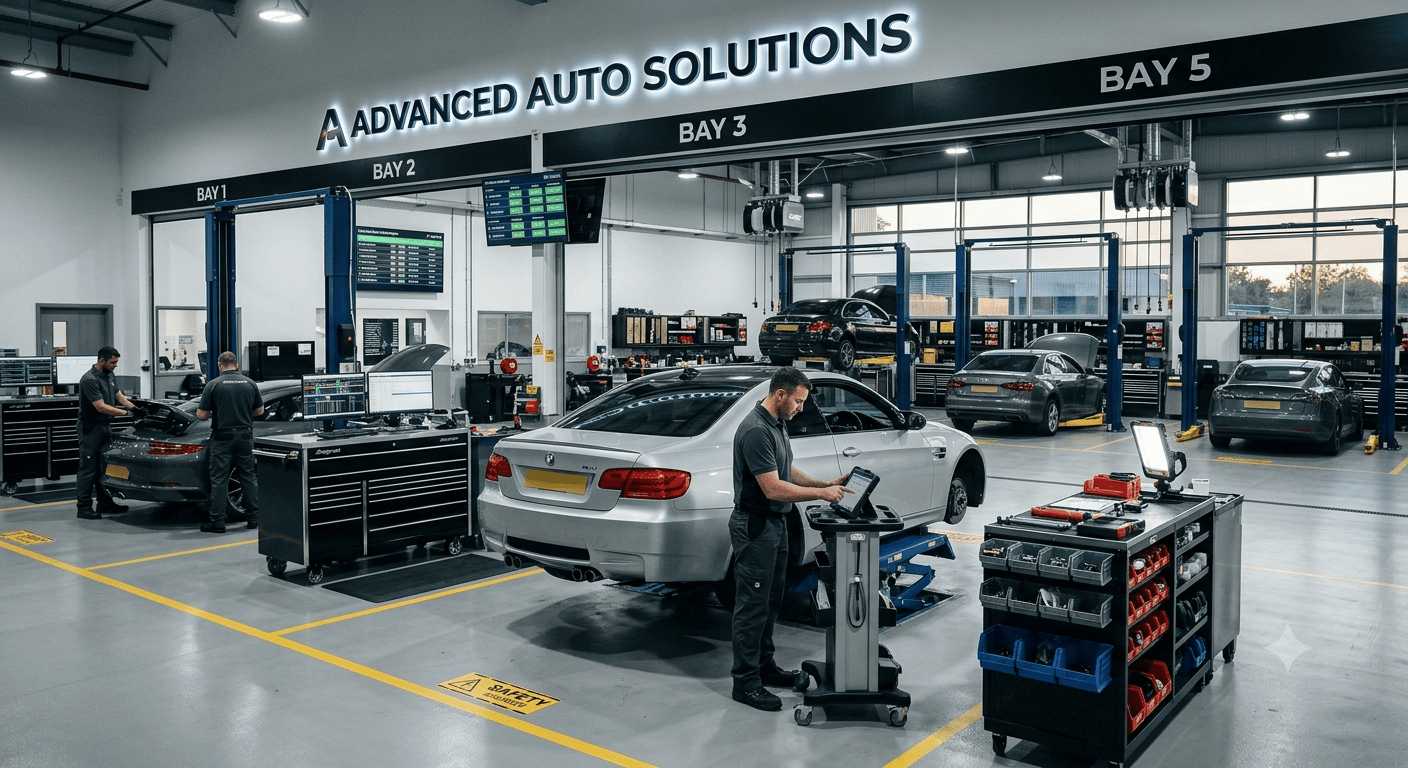
This engagement was with an established automotive service and repair business in Kannur, Kerala, operating across three distinct service divisions: a Mechanical & General Service Division handling routine vehicle maintenance and repairs; a Bodyshop Division offering denting, painting, and restoration work; and a Car Washing & Detailing Division providing cleaning and finishing services as standalone offerings and as the final step before every vehicle delivery.
The business had built a strong reputation in its market for technical expertise and customer service. But behind that reputation, the operation was running almost entirely on people — on experience, memory, and individual relationships — rather than on a documented, repeatable system. As the business grew, that dependency was beginning to show its limits.
The Problem: A Business Running on Memory, Not Method
When Paddyhill was engaged, the business was experiencing a set of challenges that will be familiar to many growing service businesses. None of them were catastrophic in isolation. Together, they created a business that was difficult to manage, difficult to scale, and impossible to hand over.
Paper-Based Job Cards with No Centralised Data
The business had a job card process, but it was entirely paper-based. Records remained on paper, with no centralised system to store, search, or refer back to them. This made it impossible to track job history, retrieve customer records quickly, or generate any meaningful data from past work.
No visibility into job progress
Once a vehicle entered the workshop, there was no system tracking which technician was working on it, what stage the job was at, or when it was expected to be completed. The workshop supervisor had to physically walk the floor to understand what was happening — and management had no visibility at all unless they asked.
Uncontrolled spare parts issuance
Parts were issued to technicians informally, with no documentation linking parts consumed to specific job cards. This created billing gaps, stock discrepancies, and an inability to reconcile what was used against what was billed — a direct source of revenue leakage.
No procurement approval process
Purchases were initiated verbally, without formal approval, and often without checking existing stock levels first. There was no purchase requisition process, no comparison of vendors, and no system record of what had been ordered or why.
Fragmented customer management
Enquiries came in through multiple channels — walk-in, WhatsApp, referrals, online listings — but were tracked informally, if at all. Follow-ups were missed. There was no data on enquiry conversion rates, no systematic service reminder process, and no structured approach to customer retention.
Unreliable financial information
Expense recording was delayed and inconsistent. Month-end closing was not happening within any defined timeframe. Management had no reliable Profit & Loss statement or Balance Sheet — which meant financial decisions were being made without accurate information.
Our Approach: Process First, Technology Second
Paddyhill's engagement followed its five-phase consulting model — Assess, Design, Implement, Train, and Review — applied specifically to the operational context of a multi-division service business.
Phase 1 — Business Assessment & Process Mapping. We began with structured interviews and on-site observation across all functions. Every process was mapped end-to-end: customer arrival, vehicle intake, job assignment, parts management, billing, delivery, and post-service follow-up. Financial workflows were assessed in equal detail. The goal was to understand how work actually moved through the business before designing how it should move.
Phase 2 — SOP Design & Process Standardisation. Based on the assessment, Paddyhill designed a comprehensive SOP framework covering 23 procedures across six functional domains: Workshop Operations, Inventory Management, Customer Management, Accounting & Finance, Administration & HR, and Zoho System Administration. Each SOP defined objectives, responsibilities, step-by-step procedures, control measures, and required records — forming a complete operations manual that the business could own and evolve independently.
Phase 3 — System Configuration & Implementation. Zoho Books and Zoho Bigin were configured precisely to support the documented SOPs — not the other way around. Zoho Bigin was set up with three operational pipelines: a Sales Pipeline for enquiry and lead management, an Operations Pipeline tracking every vehicle through intake, job execution, and delivery, and a Customer Complaint Pipeline for structured resolution management. Zoho Books was configured for estimates, purchase orders, delivery challans, invoicing, expense management, and financial reporting.
Phase 4 — Training & Go-Live Support. Role-specific training was delivered to every user group — Service Advisors, Store Incharge, Accounts Executive, Workshop Supervisor, and Front Office Executive. Sessions were practical and hands-on, covering both system operation and SOP adherence. Go-live support was provided throughout the transition period to resolve queries and reinforce the new processes.
Phase 5 — Review & Sustainability Check. Following go-live, Paddyhill conducted a structured review to assess SOP adherence, dashboard usage, and configuration gaps. This phase exists specifically to ensure the transformation delivers sustained improvement — not just a successful launch that gradually reverts to old habits.
What Changed
Workshop Operations
Vehicle intake is now standardised with a mandatory job card capturing customer information, vehicle details, reported complaints, photographic evidence of pre-existing condition, and a preliminary estimate — recorded simultaneously in Zoho Bigin. Technician assignments are documented with start times, and supervisor sign-off is required before any job proceeds to billing. A Daily Operations Meeting was introduced to align all departments each morning, with a rotating meeting leader to build shared accountability across the team.
Inventory & Procurement
All spare parts requisitions now follow a documented Purchase Requisition Form workflow. The Store Incharge verifies stock availability in Zoho Books before any purchase is initiated. Parts issued to the workshop are tracked and linked to specific job card numbers, and goods received are matched against purchase orders before bills are converted. Daily stock reconciliation and monthly physical counts ensure system records stay accurate.
Customer Management
All enquiries — regardless of channel — are now captured in the Sales Pipeline in Zoho Bigin. Automated follow-up tasks ensure no lead is lost or forgotten.
A key improvement to the customer experience was the introduction of automated WhatsApp updates at every stage of the service journey — from vehicle intake confirmation through job assignment, work completion, quality check, and final delivery. Customers are kept informed without any manual effort from the team, creating a professional and transparent communication experience throughout.
After delivery, feedback is collected within a specified timeframe and recorded in the system. Service reminders are triggered automatically against next-service dates, and customers who have been inactive for a specified period are flagged for retention follow-up.
Finance & Reporting
Month-end closing is now a structured five-step process culminating in a locked accounting period in Zoho Books. Management receives a Profit & Loss Account and Balance Sheet by the fifth of every following month. Payroll is processed on a defined schedule with an approved technician incentive matrix, and all salary entries are recorded in Zoho Books.
The Results
Real-time workshop visibility — management can see the status of every vehicle in the workshop, technician allocation, and expected delivery timeline at any point in time.
Full job accountability — every job card records the assigned technician, start and completion time, and supervisor sign-off before billing, eliminating undocumented work.
Inventory control — all parts movements are documented and tracked, and daily reconciliation ensures parts issued match parts billed, closing a previously significant revenue leakage gap.
Reliable financial reporting — month-end closing now happens on schedule, and management receives accurate financial statements within five days of period end.
No lost enquiries — all leads from walk-in, WhatsApp, referrals, and online channels are captured and tracked in a single pipeline with automated follow-up tasks.
Consistent customer experience — standardised vehicle intake, mandatory pre-delivery quality check, 48-hour feedback collection, and approved communication templates have significantly improved customer satisfaction.
Secure system governance — role-based access in Zoho Books with two-factor authentication and quarterly access review ensures financial data remains accurate and accessible only to authorised personnel.
The Paddyhill Difference
What distinguished this engagement from a standard software implementation was the consulting-led methodology. Paddyhill did not configure Zoho to reflect existing habits. We first re-engineered the underlying business processes — identified what was missing, what was inconsistent, and what needed to be built from scratch — and then aligned the technology precisely to those improved processes. The business now operates with a documented, auditable, and scalable system. Staff at every level have clearly defined responsibilities. Management has real-time visibility through structured dashboards and monthly reports. The business is no longer dependent on any individual's knowledge, memory, or presence — it runs on a system.
This is the core philosophy Paddyhill brings to every engagement: the business should be capable of running independent of its owner. Technology is the vehicle for that independence — not the destination.