
A practical guide for restaurant owners who want better control, clearer financial visibility and systems that support business growth.
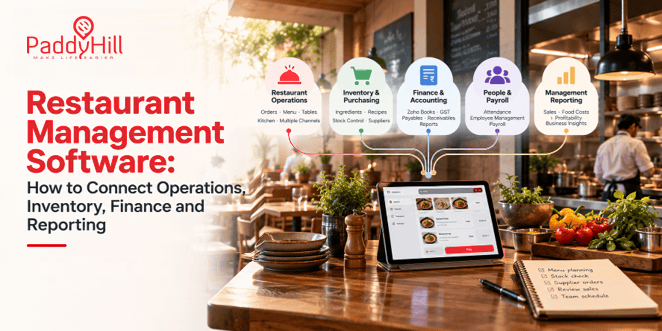
A restaurant can be busy every day, serve hundreds of customers and generate substantial sales, yet still struggle to maintain healthy profits. The reasons are not always obvious. Food wastage may go unnoticed. Purchasing may not be aligned with actual consumption. Delivery-platform commissions may reduce margins. Accounting records may be updated separately from daily operations. And the owner may have to collect information from several systems just to understand how the business is performing.
These challenges become more significant as a restaurant expands, adds new ordering channels or operates multiple outlets.
The solution is not necessarily to introduce more software. It is to design the right business processes and connect the systems that support them.
With Zoho's entry into the restaurant point-of-sale (POS) market in India, restaurant owners have another opportunity to consider how their operational and back-office systems can work together.
1. Why restaurant management is more than billing
A POS system is often the first step in restaurant digitalisation. It records orders, calculates bills and captures payments. However, a restaurant's operations extend far beyond the billing counter.
Menu management and pricing.
Dine-in, takeaway and online orders.
Kitchen preparation and service.
Ingredient purchasing and inventory.
Recipe costing and food wastage.
Supplier management and payments.
Accounting, taxation and financial reporting.
Employee administration, attendance and payroll.
Customer relationships and marketing.
Management reporting and business planning.
These functions are interconnected. Introducing a new menu item affects ingredient requirements, purchasing, stock management, pricing and food costs. Adding a delivery platform affects order handling, commissions, payment settlements and profitability.
2. The problem with disconnected systems
Imagine a restaurant using a POS system for billing, spreadsheets for stock management, a separate accounting application and manual processes for employee administration. Each system may work reasonably well on its own. The difficulty arises when information must move between them.
- Sales and accounting: Daily sales are recorded in the POS, but someone must manually consolidate the information and enter or reconcile it in the accounting system.
- Purchasing and inventory: Employees order ingredients based on experience rather than reliable consumption data and stock levels.
- Recipes and food costs: The restaurant knows the selling price of each dish but may not know its actual ingredient cost or how wastage affects its margin.
- Delivery-platform settlements: Orders, discounts, commissions, refunds and settlements need to be reconciled to understand the actual proceeds.
- Management reporting: The owner waits for separate reports from operations, accounts and HR before reviewing overall performance.
The result can be duplicated work, inconsistent information, delayed decisions and weaker operational controls. A connected system can reduce these problems, but only when the processes and integrations are designed correctly.
3. What does a connected restaurant-management system look like?
A connected system brings the information generated by restaurant operations into the wider business-management environment. The objective is to give employees the tools they need to perform their work while giving management reliable information for decision-making.
A. Restaurant operations and POS
The POS is the operational starting point for orders, billing and customer service. Zoho POS for Restaurants, introduced in India in October 2026, includes restaurant-specific capabilities such as menu management, table service, kitchen order tickets, multiple ordering channels, recipe and ingredient management, inventory, purchasing and reporting.
These features help bring several front-of-house and back-of-house activities into one operational platform. The potential benefit is better coordination between the people taking orders, preparing food, managing stock and handling payments.
Official product information: https://www.zoho.com/en-in/pos/restaurants/
B. Inventory and purchasing
Inventory is one of the most important areas of restaurant cost control. Unlike a conventional retail business that mainly tracks finished products, a restaurant consumes ingredients to prepare dishes. It must also account for preparation batches, wastage, spoilage and variations in actual usage.
A well-designed process should address:
Supplier selection and purchasing approvals.
Receiving and checking purchased ingredients.
Recording stock quantities and costs.
Defining recipes and standard ingredient quantities.
Monitoring consumption against expected usage.
Recording wastage and stock adjustments.
Setting replenishment levels.
Managing transfers between outlets where applicable.
Zoho POS for Restaurants includes recipe-based ingredient tracking, stock management, purchasing and vendor workflows. For businesses with more complex requirements, the suitability of a separate inventory application such as Zoho Inventory should be assessed carefully. It should not be assumed that adding another application will automatically improve restaurant inventory control; workflow, data ownership and integration requirements must first be established.
C. Finance and accounting
Daily restaurant transactions need to translate into reliable financial records. Zoho POS integrates with Zoho Books, connecting restaurant operations with accounting and reducing the need for manual data entry between the systems.
Zoho Books can support financial accounting and reporting, GST-related records and compliance workflows, supplier bills and payments, receivables, bank reconciliation and operating expense tracking.
The integration should be evaluated in terms of the actual data synchronised, transaction mapping, tax treatment, payment reconciliation and handling of refunds or corrections. A restaurant receiving payments through cash, UPI, cards and delivery platforms must ensure that the accounting process reflects correct settlement amounts, fees and outstanding balances.
The aim is not merely to transfer sales data. It is to maintain accurate and reconcilable financial records.
Official information: https://www.zoho.com/in/books/
D. Employee administration and payroll
Restaurants depend heavily on their employees. Attendance, shift allocation, employee records and payroll can become difficult to manage as the workforce grows.
Depending on requirements, applications such as Zoho People and Zoho Payroll may support employee records and onboarding, attendance and leave management, employee administration, payroll processing and applicable statutory calculations. Exact capabilities and availability depend on the applications, plans and configuration involved.
These systems should be considered part of the wider business-management architecture where the benefits justify the additional cost and implementation effort.
Official information: https://www.zoho.com/people/ and https://www.zoho.com/in/payroll/
E. Expenses and financial controls
A restaurant incurs many expenses beyond food purchases: rent, electricity, repairs, equipment, cleaning supplies, delivery charges and employee-related costs.
A clear expense-management process helps the business record expenditure, enforce approval limits and review spending against budgets. Zoho Expense may be useful where employee expense claims, reimbursements and approval workflows need to be managed systematically. Routine supplier bills and other operating expenses may be handled through the accounting system, depending on the workflow.
The objective is to establish clear rules for who can spend, who approves expenditure and how expenses are recorded.
F. Management reporting and analytics
Business owners need more than a daily sales total. They need information that helps them understand what is happening, why it is happening and what action may be required.
Useful measures may include:
Sales by outlet, item and channel.
Average order value.
Food cost as a percentage of sales.
Ingredient consumption and wastage.
Gross margin by menu item, where reliable cost data is available.
Purchasing trends and supplier costs.
Operating expenses.
Employee costs relative to revenue.
Delivery-platform fees and settlement differences.
- Cash flow and overall profitability.
Zoho POS provides operational dashboards and reports. Zoho Books provides financial reports, while Zoho Analytics can be used to build additional dashboards and combine information from multiple sources where relevant connectors and data models are available.
Consolidated reporting depends on data quality, suitable integrations and consistent definitions. A dashboard cannot compensate for incomplete stock records, incorrect recipe quantities or unreconciled transactions.
Official information: https://www.zoho.com/analytics/
4. How these systems work together
Consider a simplified example of a restaurant selling a meal:
Step 1 — The customer places an order. The POS records the items, applicable prices, order type and payment information. The order is routed through the restaurant's preparation workflow.
Step 2 — The kitchen prepares the meal. Recipe and ingredient records can help the restaurant track expected stock consumption as items are sold, subject to the configured workflow.
Step 3 — Inventory and purchasing are reviewed. The restaurant monitors available ingredients and identifies replenishment requirements. Purchasing decisions can be based on stock levels, expected demand and supplier arrangements.
Step 4 — The financial transaction is recorded. The POS and Zoho Books integration connects restaurant transactions with accounting. The business must still configure and verify the relevant mappings and reconciliation procedures.
Step 5 — Management reviews performance. The owner reviews sales, purchasing, stock, expenses and financial results through available reports and any additional analytics configured for the business.
This is an illustration of a connected operating model, not a guarantee that every step is automated by default. Each data flow must be verified against actual product capabilities and the restaurant's requirements.
5. Does every restaurant need the entire Zoho ecosystem?
No. A small café with one outlet may need a relatively simple POS and accounting setup. A multi-outlet restaurant group with central purchasing, complex recipes and several delivery channels may require more advanced processes and reporting.
The appropriate solution depends on:
Number of outlets and employees.
Transaction volume and ordering channels.
Complexity of recipes and ingredient consumption.
Inventory and purchasing requirements.
Accounting and compliance needs.
Existing software and hardware.
Management reporting requirements.
Budget and internal capacity to maintain the systems.
A phased implementation is often more practical than attempting to introduce every application at once. A business may begin with POS and accounting, stabilise its sales and reconciliation processes, then improve inventory controls and introduce additional reporting as needs develop. Solve the most important business problems first.
6. Five questions to ask before choosing restaurant software
- Can I understand my actual profitability? Do I have reliable information about sales, ingredient costs, operating expenses, commissions and other significant costs?
- Can I control inventory and wastage? Are recipes, stock movements, purchases and wastage recorded consistently?
- Are my operational and financial records connected? Can transactions flow into accounting appropriately, and can I reconcile payments and settlements?
- Can I get reliable reports without manual consolidation? Do the reports answer the questions I need to make business decisions?
- Will the system support future growth? Can it accommodate additional outlets, employees, order channels and more complex reporting without creating unnecessary administrative work?
These questions encourage restaurant owners to evaluate systems based on business outcomes rather than features alone.
7. Where AI could add value
Once restaurant data is reliable and connected, AI-enabled tools may help managers identify trends, investigate unusual changes, forecast demand and summarise performance. For example, analysis of sales and stock data could help flag unexpected consumption patterns or support purchasing decisions.
Their usefulness depends on data quality, the tools available and appropriate human review.
The sensible approach is to establish reliable processes and data first, then introduce AI where it addresses a clear business problem.
8. Why implementation and business-process design matter
Software is only one part of the solution. A successful implementation begins by understanding how the restaurant operates, identifying gaps and agreeing on how the processes should work.
That may involve defining purchasing approvals, standardising recipes, establishing inventory procedures, mapping accounting transactions, assigning responsibilities and deciding which reports management will review.
The implementation team must then configure the software, validate the integrations, test realistic scenarios and train employees. The restaurant should also establish a review process after implementation: are stock differences reducing, are payment settlements reconciling correctly, are managers using the reports, and are employees following agreed procedures?
Without this discipline, even a capable system can become another disconnected tool.
Conclusion: Build a system that helps the restaurant run better
Zoho's entry into the restaurant POS market creates a timely opportunity for restaurant owners to rethink how they manage operations and connect them with finance and administration.
The real value is not simply in recording more transactions or using more applications. It is in creating reliable processes, connecting relevant information and giving owners better control over their businesses.
At Paddyhill Consultancy Services, we approach business systems from the process perspective first. We work to understand how a business operates, identify the gaps, design practical workflows and implement suitable technology to improve visibility, control and efficiency.
Are your systems helping you manage the business, or are you still spending too much time joining the dots?
About Paddyhill Consultancy Services
Paddyhill Consultancy Services helps businesses streamline processes, implement business systems and improve operational control through practical management consulting and technology-enabled solutions. Our focus is to help businesses build systems that support better decisions, stronger processes and sustainable growth.
Website: https://paddyhill.com/