
Why Getting It Right Is the Foundation of a Profitable Business
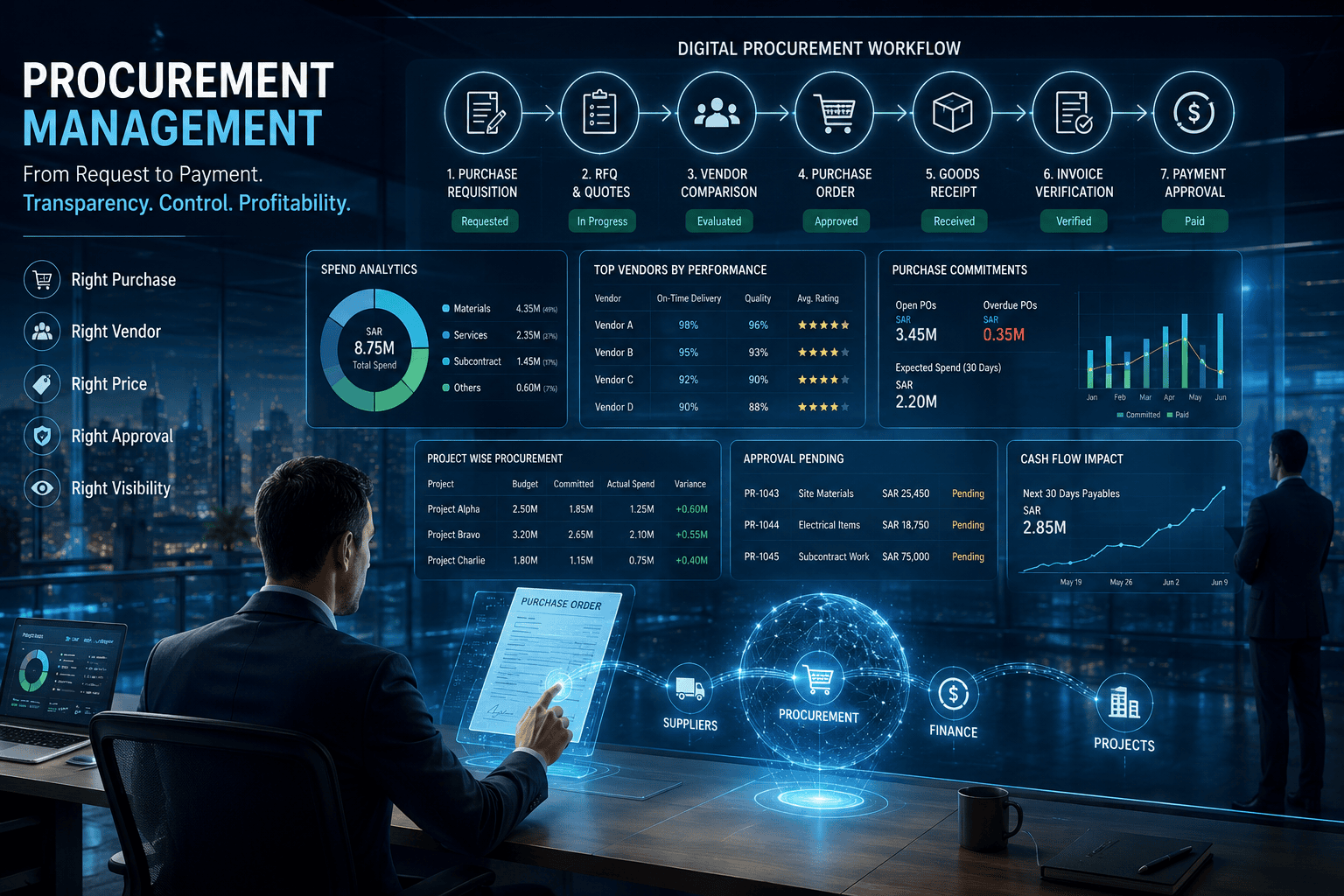
Ask most business owners where their profits are being lost and they will point to sales, pricing, or overheads. Rarely do they examine how purchases are being made — who is buying what, from whom, at what price, and with whose approval. Yet for most small and medium businesses, procurement touches every rupee spent on goods and services. An unmanaged procurement process is quietly one of the largest sources of financial leakage in any organisation.
What Is Procurement Management?
Procurement management is the structured process by which a business identifies its need for goods or services, sources them from the right vendors, places formal orders, receives goods, and settles payments — with appropriate approvals and documentation at every stage.
At its core, it answers four questions: What is being purchased and is it genuinely needed? From whom — and has the vendor been evaluated? At what price — and has it been compared to the market? Authorised by whom — and is there a record of that authorisation?
The standard stages of a procurement cycle are: Purchase Requisition → Approval → Request for Quotation (RFQ) → Vendor Selection → Purchase Order Issuance → Goods Receipt → Supplier Bill Verification → Payment. Each stage, when documented and controlled, creates accountability, prevents overpayment, and gives management real-time visibility into the organisation's financial commitments.
Procurement Across Industries
While the core logic is universal, procurement looks different depending on the business.
General contracting and construction: Procurement is project-driven. Materials must be tracked against specific projects to determine profitability, and purchase requests often originate from site managers who need approvals to flow quickly through a remote chain of command.
Trading and distribution: Procurement is the business model itself — the margin between buying price and selling price is the primary profit lever. A purchase request may be triggered by a customer enquiry, and the cost update from vendor quotes must flow directly into the sales quotation.
Manufacturing: Raw materials, consumables, and outsourced processing require precise lead-time management. Over-purchasing ties up working capital; under-purchasing halts production.
Hospitality, healthcare, and professional services: The challenges vary — perishable goods, regulatory compliance, or subcontractor expenses — but the underlying need is identical: a controlled, documented process that prevents unauthorised spending and gives management an accurate picture of committed costs.
The Cost of Informal Procurement
The default state for most SMEs is informal procurement. Someone needs something, they call a known vendor, agree verbally, receive the goods, and the accountant pays the bill when it arrives — no purchase request, no quote comparison, no formal purchase order. This works when the business is small enough for the owner to personally oversee everything. It breaks down as the business grows. The costs are predictable:
Financial leakage accumulates from purchases made without budget checks or competitive pricing.
Duplicate payments and billing errors go undetected when vendor invoices are not matched against purchase orders and goods receipts.
Management visibility disappears — there is no real-time view of outstanding purchase commitments or what the business owes.
Project cost control becomes impossible when purchases cannot be tracked by project, making it difficult to know whether a contract is profitable until it is too late to act.
Undocumented procurement creates serious compliance exposure in businesses with auditors or investors.
How to Build a Streamlined Procurement Process
Streamlining procurement is a process design exercise first and a technology exercise second. The principles that underpin any well-functioning procurement system are:
Separate the requester from the approver. No one should initiate and approve their own purchase.
Standardise the purchase request. Every procurement begins with a documented request specifying what is needed, in what quantity, and for what purpose or project.
Enforce vendor comparison. Above defined thresholds, at least two or three vendor quotes must be collected and recorded before a purchase order is issued.
Make the PO the commitment document. No goods should be received and no invoice paid without a corresponding purchase order on file.
Three-way match before payment. Every vendor payment should be preceded by matching the invoice against the purchase order and the goods receipt.
Integrate procurement with accounts. The procurement process should flow directly into the accounting system, eliminating duplicate data entry and ensuring all commitments are reflected in the books.
From Purchase Request to Paid Bill — Digitalised with Zoho
Once the process is designed, the right platform gives it structure, enforces it consistently, and makes it visible to management in real time. Zoho's Finance and Operations Suite offers purpose-built applications that cover the full source-to-pay cycle — scalable to the size and complexity of the business.
Zoho Procurement is Zoho's dedicated procurement management application, covering the entire source-to-pay process in one place. Purchase requisitions are raised by any team member and routed automatically for approval. Approved requests move into the RFQ process where multiple vendor quotes are collected, compared, and evaluated. The selected offer is converted into a formal purchase order, goods receipts are recorded on delivery, and vendor bills are matched against the PO before payment is released — all within a single, connected workflow with a full audit trail.
Zoho Spend is Zoho's broader spend management platform for organisations that need consolidated control across procurement, accounts payable automation, employee expenses, corporate travel, and payroll in one system. It is designed for businesses that want a holistic, real-time view of every category of company spend — from a purchase order to a staff reimbursement — under one governance framework.
Zoho Books serves as the financial back-end: supplier bills, payment processing, and project cost allocation are managed within Zoho Books, ensuring that every procurement commitment is reflected in the accounts in real time. For project-based businesses, purchases and bills can be allocated to specific projects, enabling accurate project profitability tracking without manual consolidation.
Zoho ERP brings procurement into a fully integrated operations and finance ecosystem for businesses managing inventory, manufacturing, or multi-location operations — connecting procurement with stock management, production planning, and financial reporting in a single system.
The right combination depends on the size, structure, and complexity of the business. What remains constant is the outcome: management visibility into every purchase commitment, a controlled approval process at every stage, and a complete audit trail from requisition to payment.
Three Companies, One System: A Procurement Transformation in Saudi Arabia
One of our most comprehensive procurement engagements was with a Dammam-based business group operating three distinct legal entities — a general contracting company, a specialised trading company, and a specialised contracting establishment — all under common management.
The Challenge
Despite sharing the same leadership and team, the three entities had no unified procurement process. Purchase requests were informal, quotes were collected ad hoc, and formal purchase orders were largely absent. Each entity maintained separate books with no consolidated financial visibility, and the CEO had no real-time view of the group's procurement commitments or outstanding payables.
Our Approach
Our engagement began not with software, but with understanding. We spent time with the management team, the procurement function, and the project teams to map how work actually moved through each entity — where decisions were being made, where approvals were missing, and where financial visibility broke down. We examined how the trading business moves from customer enquiry to purchase to delivery, and how the contracting business tracks costs across active project sites.
From that understanding, we designed distinct procurement and financial workflows tailored to the way each operation actually works. Zoho Books and Zoho Expense were then configured to run those workflows — giving the business a system that reflects its operational reality, not a generic template.
For the trading entity, the workflow connects sales and procurement end to end: the sales team raises a purchase request and initiates an RFQ process to obtain the latest supplier pricing. Once vendor quotes are collected and the best price is finalised, the item master is updated accordingly, and the sales quotation to the customer is then generated based on the updated pricing. On confirmation of the order, a formal purchase order is issued to the vendor. On delivery, goods receipt notes are generated in Zoho Books, the supplier bill is verified against the PO, and customer invoicing and supplier payment are completed within the same integrated system.
For the contracting entity, a project-centric workflow was designed: every purchase request originates from the Project Manager, flows through procurement approval, and all costs — materials, supplier bills, and field expenses — are allocated to the specific project in Zoho Books, giving management real-time project profitability data for every active contract.
Role-based access was configured across both systems so that each team member — Sales, Procurement, Project Manager, Accountant, and CEO — operates within defined boundaries, with appropriate approval rights at every stage. No commitment and no disbursement can proceed without the right authorisation.
The Outcomes
A unified purchase-to-pay process replaced informal practices across all three entities.
Petty cash and field expenses moved to a digital, approval-based workflow.
The contracting entities gained project-level profitability visibility for the first time.
The CEO now has consolidated, real-time dashboards across all three companies — financials, receivables, payables, and procurement commitments — without waiting for a manual report.
Procurement Is Strategy. Treat It That Way.
The businesses that consistently maintain healthy margins and scale without proportional complexity are those that treat procurement as a strategic function — not an administrative afterthought. They know what they are spending, with whom, at what price, and why. Their management teams have real-time visibility into financial commitments. And their processes run consistently regardless of who is in the office.
For SMEs, achieving this does not require an expensive enterprise system. It requires a well-designed process and the right integrated platform. At Paddyhill, our approach is always to understand the business first, design the process second, and implement the technology third — because a system built around how the business should work, rather than around software features, is what delivers lasting results.