
Introduction
The moment sales rise and the workload increases, cracks begin to show:
Communication slips.
Quality becomes inconsistent.
Employees get overwhelmed.
The owner becomes the bottleneck.
At Paddyhill, we’ve seen it across countless SMEs: the problem isn’t growth — it’s the lack of systems to support it.
The Growth Illusion — Why SMEs Hit the Wall
In the early phase, businesses grow through hustle. Everyone does everything. Decisions are quick. Processes are informal.
But as the business expands, the same informality becomes the enemy:
Team members duplicate tasks because nothing is documented.
Customer experience becomes inconsistent.
Internal coordination slows down.
The owner gets pulled into every decision.
What once felt agile now becomes unmanageable.
Growth exposes the weaknesses that existed all along.
What System Design REALLY Means (And Why It’s Non-Negotiable)
It defines:
How work flows
Who takes ownership
What success metrics are tracked
How decisions are made
How teams collaborate
When systems are in place, the business becomes self-sustaining — instead of owner-dependent.
The Four Silent Scalability Killers in SMEs
1. Undefined, Unrepeatable Processes
Employees “figure things out” every time, leading to inconsistent results.
2. Roles Without Boundaries
People do everything — which means no one truly owns anything.
3. Tools That Don’t Talk to Each Other
Businesses invest in software without designing the workflow first.
4. Owner-Dependency at Every Step
Nothing moves unless the owner approves it — a guaranteed growth killer.
System Design: How It Saves the SME from Implosion
When processes, roles, and responsibilities are clearly structured, everything changes:
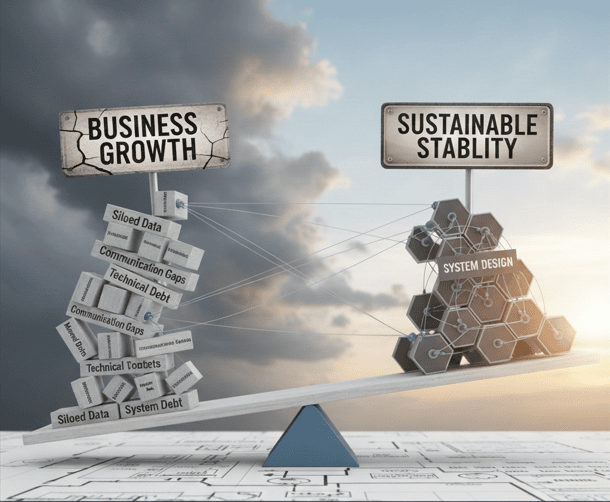
System design turns the business into a structure that supports scaling — instead of collapsing under it.
How Paddyhill Brings Structure to Growing Businesses
Our approach includes:
Mapping your key processes
Redefining roles and accountability
Optimizing workflows for clarity
Designing system-centric operations
Selecting tools after processes are defined
Conclusion
And the businesses that scale successfully are not the ones with more people or more software — but the ones with strong systems that keep everything aligned, consistent, and under control.