
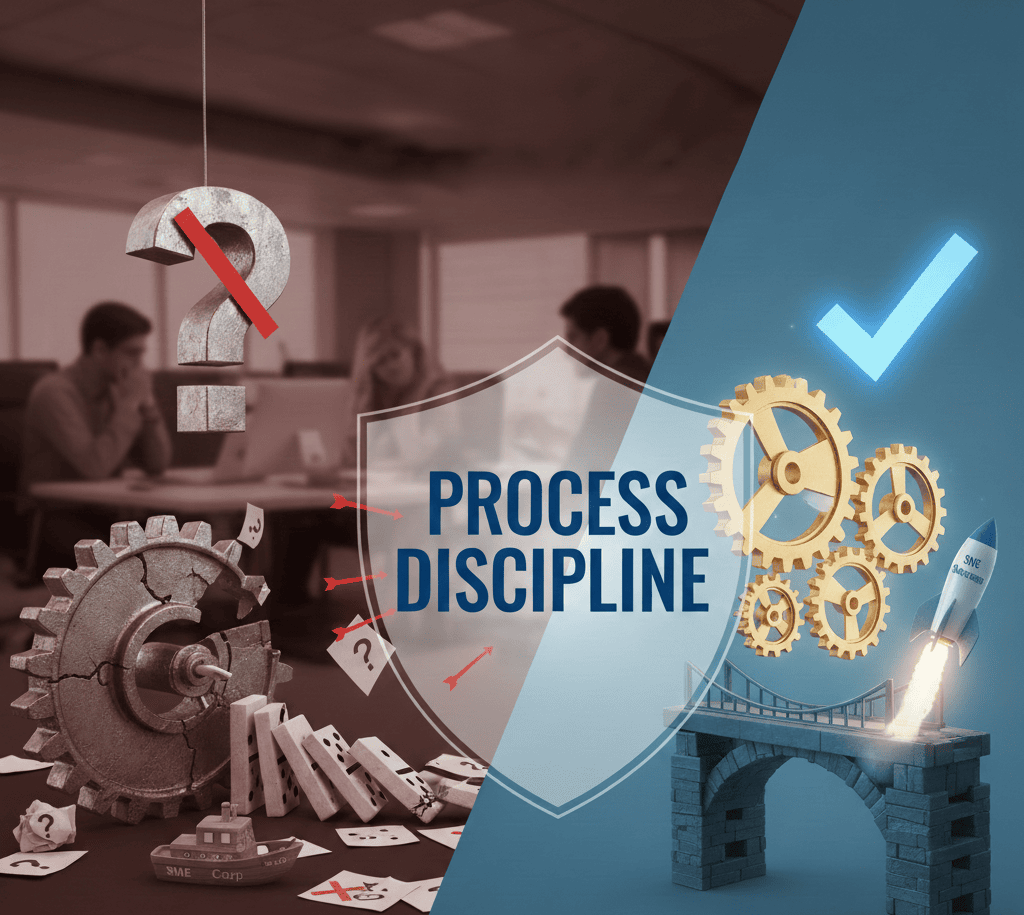
Most business owners believe poor outcomes come from poor decisions.
You may decide to expand, hire, invest, or enter a new market — yet results fall short. Not because the idea was wrong, but because execution lacked structure, follow-through, and clarity.
At Paddyhill, we’ve seen that strong businesses are not driven by smarter decisions alone — they are driven by disciplined processes that support those decisions.
1. The Decision vs Execution Gap
In SMEs, decisions are often made quickly — but execution is informal.
Common patterns include:
Decisions communicated verbally with no documentation
No clear owner responsible for execution
No timeline or checkpoints
No visibility on progress
The decision fades, teams interpret it differently, and momentum is lost.
2.Why SMEs Struggle With Process Discipline
Process discipline is often misunderstood as bureaucracy. In reality, it’s about clarity and consistency.
SMEs avoid it because:
“We’re too small for processes”
“Processes slow us down”
“Everyone already knows what to do”
But without discipline:
Accountability disappears
Quality becomes inconsistent
Owners keep stepping in to fix issues
3. What Process Discipline Actually Looks Like
Process discipline doesn’t mean heavy documentation. It means:
When discipline exists, teams execute confidently — without constant supervision.
4.How Process Discipline Improves Decision Outcomes.
When decisions are supported by structured execution:
Teams know what to do
Owners know who is responsible
Progress is visible
Issues surface early
Decisions deliver real impact
Good ideas stop dying quietly.
5. The Paddyhill Perspective
At Paddyhill, we help SMEs turn decisions into results by:
Structuring execution workflows
Assigning ownership clearly
Introducing lightweight review mechanisms
Building discipline without complexity
Because a decision is only as strong as the process that follows it.
Conclusion
Process discipline is what turns intention into impact.